Spark plugs

Since 1959, DENSO has become one of the world’s leading pioneers of OEM quality spark plug technology

Spark plugs

How spark plugs work

Known as the ‘heart of the engine’, spark plugs play a key role in the ignition and performance of the entire engine. The well-timed combustion of the fuel-air mixture of gasoline and oxygen is what generates power in gasoline engines. The precise timing of the spark created by the spark plug ignites the fuel, triggering combustion.

To create this spark, a high voltage is passed between the centre electrode and ground electrode of the spark plug. This voltage breaks down the natural insulation between these electrodes and an electrical spark is generated. Although this strong spark only lasts for about 1/1,000 of a second, it has to be precisely and reliably timed to trigger the combustion of the fuel-air mixture.

Two DENSO TT spark plugs

Features and benefits

  • Optimum performance in a compact design.
  • Built by DENSO in-house, with ‘zero defects’ as standard.
  • Designs suitable for 90% of car models.
  • Developed in-house for a wide range of applications.
DENSO spark plug electrode close up
Expert technology development
Since our first design in 1959, we’ve been working to develop our spark plug technology and improve performance. This expertise informs the design of our huge range of compact spark plugs.
High, reliable performance
As engines downsize, spark plugs still need to provide similar or improved levels of spark performance. DENSO spark plugs provide the best optimum performance in a compact design.
Suitable for many applications
Our spark plugs are suitable for 90% of car models and are designed to provide reliable performance in a range of engine types and for various applications.

Types and characteristics

As well as designing to optimize performance, DENSO produces a range of spark plugs with different electrode shapes and sizes that are suitable for different engine applications.

Spark plugs types

Nickel TT®
Iridium TT®
Iridium Power
Iridium Tough
Iridium Racing

Characteristics

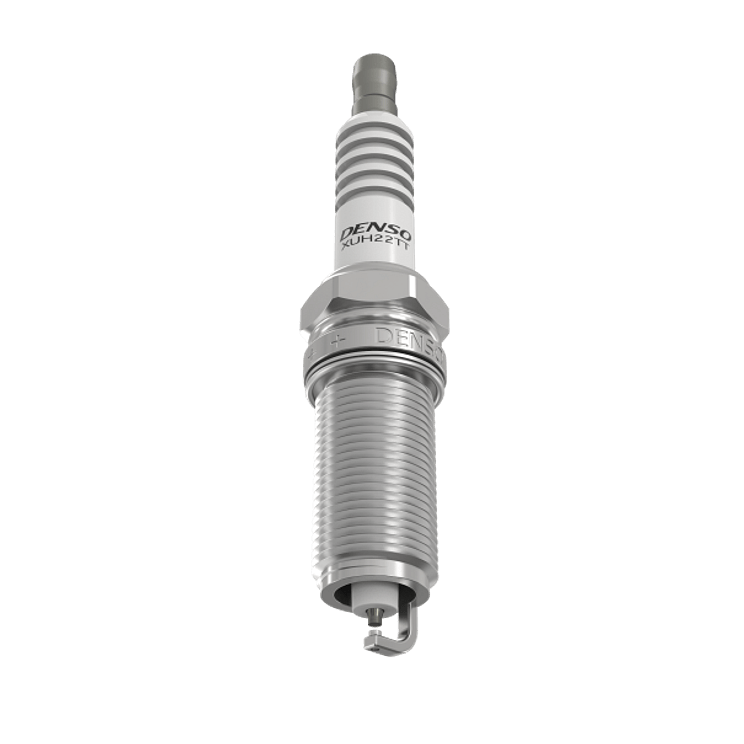
DENSO XUH22 TT Nickel TT

Leaflet

Discover how DENSO’s extensive range of spark plugs can improve the ignition performance of your OE vehicle.

Installation and fault finding

In order to find the right plug for your vehicle, you need to consider the heat range, hex diameter, total length and horsepower of the engine, as well as inspecting the condition of the current plug, to choose a new one accordingly.

Installation

Great care must be taken to ensure the safe installation of a spark plug:

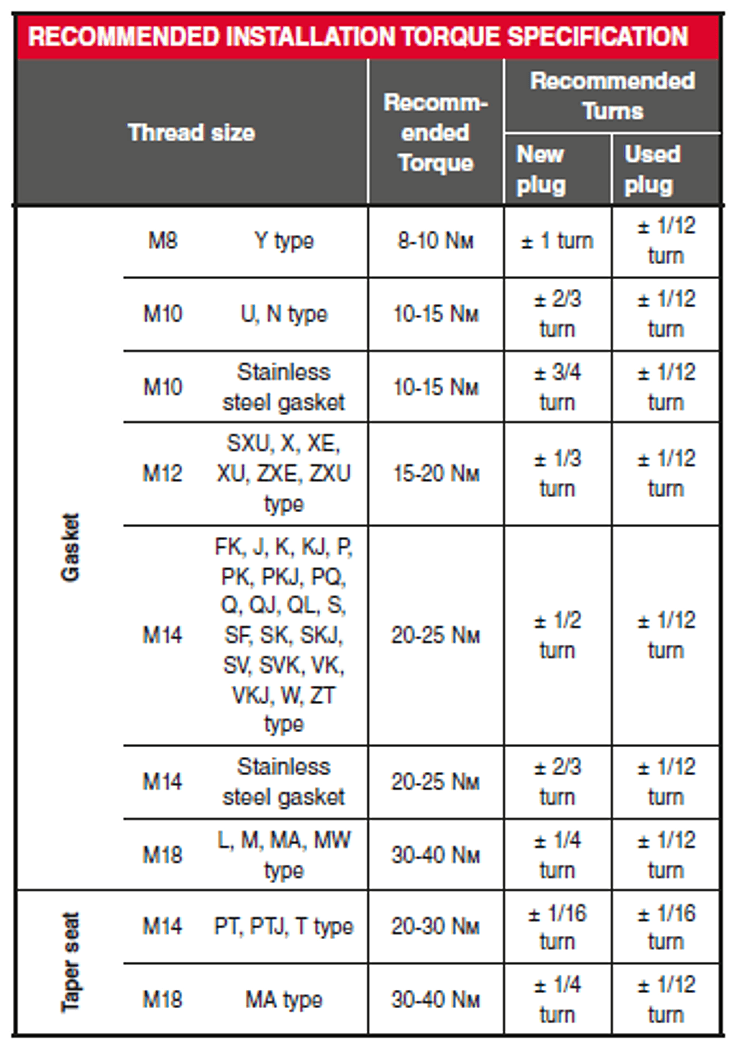
To help you ensure accurate spark plug installation first time, please follow DENSO’s specifications below:

Table

Fault finding

A spark plug’s appearance and various engine symptoms can help to diagnose damage:
01

Appearance: The insulator foot section and electrode section are covered with dried, soft black carbon.

Effects: Poor starting, misfiring, acceleration defect.

Cause: Repeated short-distance driving (driving with the engine cool), incorrect choking (overly rich air-fuel mixture), injection timing delay, plug heat range too high.

02

Appearance: The insulator section and electrode section are black and lustrous with wet oily deposits.

Effects: Poor starting and misfiring.

Cause: Oil leakage due to piston ring, cylinder, or valve guide wear (occurs easily to new engines and engines that have just been overhauled), high oil content in air-fuel mixture (2-stroke engines).

03

Appearance: The insulator leg section is scorched and extremely white with small black deposits. Rapid electrode wear.

Effects: Loss of power when running at high speed or under high load.

Cause: Spark plug incorrectly tightened, engine cooling problem, ignition timing too early, spark plug heat range too low, severely abnormal combustion.

04

Appearance: The centre electrode or ground electrode is melted or scorched. There are spots on the insulator leg section and deposits of aluminium or other metal powder.

Effects: Power loss due to engine damage.

Cause: Often this is due to overheating; pre-ignition is a phenomenon in which combustion occurs before ignition. The plug heat range is too low, the injection timing is too advanced, etc.

05

Appearance: The insulator leg section is cracked or broken.

Effects: Misfiring

Cause: Severely abnormal combustion, lack of attention to gap adjustment.